
Club History
1. Geographic Context and Meteorological Dynamics
The Club d’Aeromodelisme RC de l’Ebre flying field is situated in a strategic location within the municipality of Roquetes (Tarragona), in the Terres de l’Ebre region. Geographically, the facilities benefit from the confluence of the Els Ports Natural Park and the Ebro Delta. From a technical perspective, the Ebro Valley acts as a natural funnel that channels and accelerates air masses, creating a microclimate of high value for aerodynamic experimentation.
Operations are governed by the "Cierzo," a persistent northwest (NW) wind that guarantees constant lift conditions. However, the distinguishing factor of this enclave is its ability to generate powerful thermal updrafts even late in the season, such as in October. These conditions have fostered an institutional specialization in gliding (soaring) and precision navigation.
Competitive advantages of the microclimate for scale aviation:
Utilization of the Ebro "Trough": The funnel effect provides laminar airflows ideal for tuning wing profiles.
Slope Soaring: The foothills of the Els Ports massif allow for this technical modality, utilizing the rising air that strikes the relief.
Extended Operational Calendar: The persistence of strong thermals in October attracts pilots from across the European continent, who find Roquetes a climatic refuge from the adverse weather of Northern Europe.
2. Genesis and Institutional Evolution (1970 – Present)
The trajectory of the Club d’Aeromodelisme RC de l’Ebre is backed by over 50 years of institutional memory. Its origins in the 1970s correspond to the "handcrafted era" of aeromodeling, where construction was based exclusively on balsa wood, plywood, and highly complex technical blueprints. During that period, developing a model required months of manufacturing and the use of "glow" combustion engines.
Technical evolution has been rigorously managed by an experienced human team, transitioning from piece-by-piece construction to the era of composite materials (carbon fibers, epoxy resins) and ARTF (Almost Ready to Fly) models, which facilitate the integration of advanced electronic systems. A fundamental administrative milestone was the formalization of the flying field under the legal category of Aerodrome. This superior status, granted for compliance with civil aviation regulations, authorizes the use of the runways for Ultralight Aircraft (ULM), diversifying the technical utility of the infrastructure.
3. Technical Infrastructure and Flight Specifications
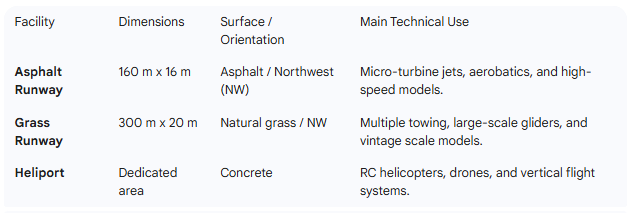
The Roquetes aeronautical complex has been designed to support high-kinetic energy operations and precision flights. The technical specifications of the operational surfaces are detailed below:
4. Aircraft Taxonomy and Technical Specialization
The diversity of the operational aircraft fleet reflects the high level of technical training among the members:
Scale Heritage Models: Scale reproductions requiring absolute fidelity to the real aircraft. Notable units include the Mustang, Spitfire, Corsair, Texan, and the Piper J3, the latter frequently used for both training and light towing tasks.
High Speed and Jet Propulsion: Operation of jets equipped with kerosene micro-turbines. These models require strict use of the asphalt runway and follow maintenance and safety protocols analogous to commercial aviation.
Large Format Gliding: The club’s core specialty. It includes high-wingspan sailplanes and tow planes. These models integrate cutting-edge instrumentation, such as vario-altimeter sensors and telemetry systems for thermal locating.
New Technologies and FPV: Incorporation of multicopters, latest-generation drones, and FPV (First Person View) systems, allowing navigation via real-time digital video transmission.
5. Milestones in Navigation and GPS Competition
The Club d’Aeromodelisme RC de l’Ebre is an international benchmark in the discipline of GPS Triangle Racing. Unlike traditional recreational flight based on ground visual references (such as pylons or flaggers), this modality requires the pilot to navigate following precise satellite coordinates transmitted to onboard electronic devices.
A historical milestone was the hosting of the European GPS Triangle Championship, held from October 2 to 15, 2022. Within the framework of the GPS Challenge Cup, four competitive categories are defined:
SLS (Self-Launch System): Gliders with retractable motors for autonomous takeoff.
1:3.5: Exact scale models at a ratio of one to three-and-a-half relative to the original.
Sport: A class focused on aerodynamic efficiency and circuit speed.
Light: Models optimized for utilizing extremely weak thermals.
6. Administrative Structure and Social Management
The entity maintains a professionalized management structure to ensure operational safety and institutional growth:
Asif Choudhry: President and Legal Representative.
Antoni Ravetllat: Treasurer.
Tomás Gorina: Vice-President.
The club's "Flight Academy" implements a pedagogical tutoring system based on high-wing models. The choice of this configuration is based on engineering criteria: its center of gravity below the wing plane provides superior pendulum stability and lower stall speeds, minimizing the risk of structural failure during dual-control instruction. The strategic planning of the entity is ratified at the annual members' meeting, the sovereign body for budgetary and technical management.
7. Conclusions and Legacy
The Club d’Aeromodelisme RC de l’Ebre represents a driver of technical and economic development for Roquetes. Through its 50-year history, it has successfully synthesized the tradition of handcrafted construction with the vanguard of satellite navigation and turbine propulsion. Its consolidation as an aerodrome and the international projection of the club has become a pillar in the preservation of aeronautical heritage and technical innovation in Southern Europe.